
The Ship · 1943–1952
Construction Log
From wartime sketches to the fastest crossing ever made by a liner: how the SS United States was designed, fought over in Washington and built in Virginia, dated from government records.
Who paid for her: $77.7 million
- National-defense features (government): $26.3 million (34%)
- Construction subsidy (government): $18.6 million (24%)
- United States Lines: $32.8 million (42%)
Source: HAER PA-647, National Park Service, 2012.
The log
Design studies begin
United States Lines commissions the first design studies for an advanced transatlantic liner while World War II is still on. Naval architect William Francis Gibbs of Gibbs & Cox leads the work.
Source: HAER PA-647
Design work starts
Full design work begins on the ship, government design number P6-S4-DS1. She is meant to double as a fast troopship in a national emergency, which is how the government justifies paying for part of her.
Source: HAER PA-647
Shipyards bid
Builders submit bids to construct the ship.
Source: HAER PA-647
Construction authorized
The government authorizes construction. The contract is awarded on May 3 to Newport News Shipbuilding and Dry Dock Co. in Virginia, where she becomes hull No. 488.
Source: HAER PA-647
The Comptroller General objects
A special report from the Comptroller General criticizes the deal. It says the government’s $25.4 million allowance for national-defense features is too high. The dispute over the subsidy and the sale price runs through the rest of construction.
Source: 1952 audit report · FMB annual report, 1950
Keel laid
Work on the hull starts at Newport News. More than 5,000 shipyard workers and over 800 suppliers in 28 states would work on her.
Source: HAER PA-647
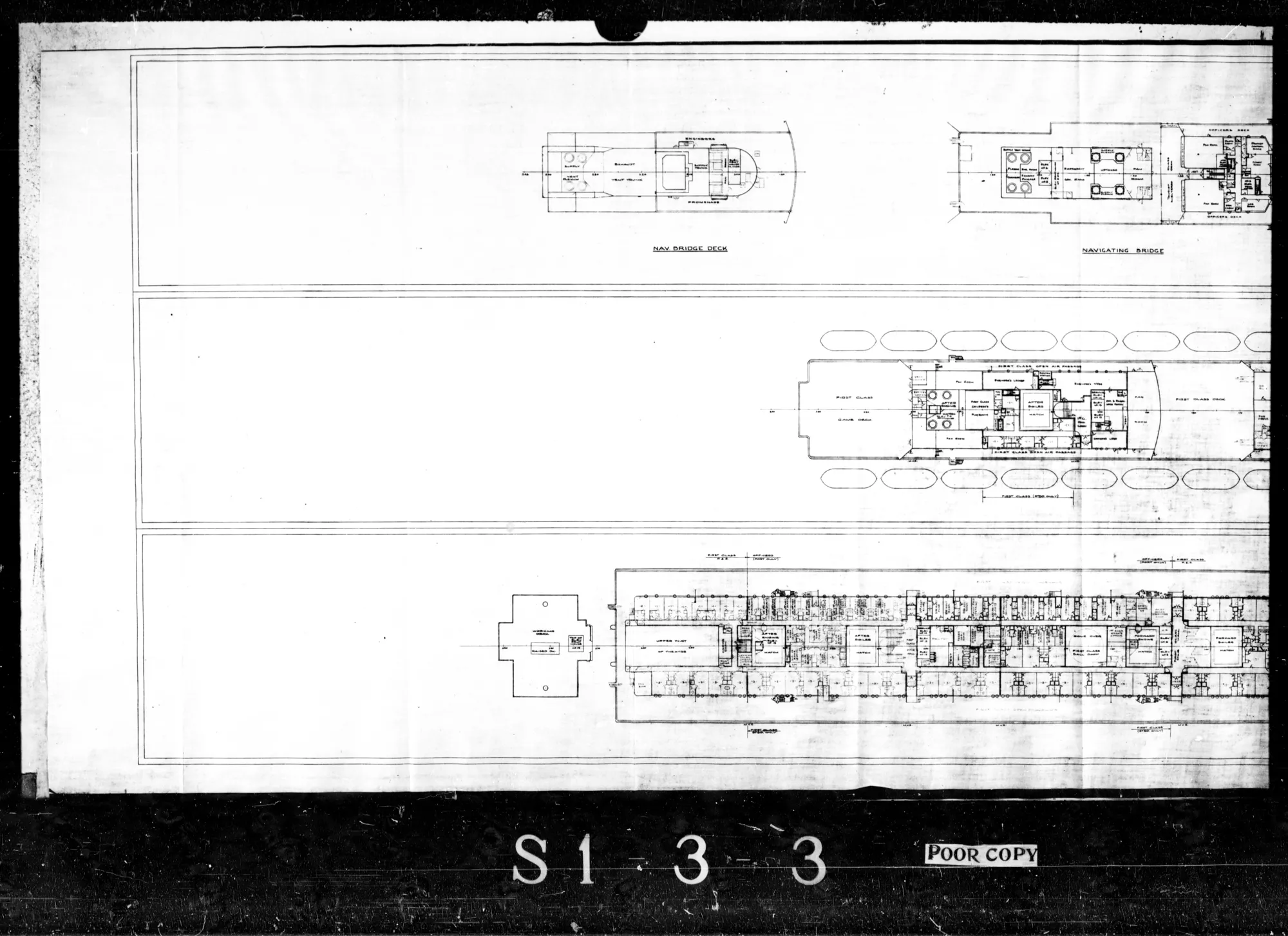
Deck plans from the ship’s construction drawings, sheet S1-3-3. National Archives, Maritime Administration drawings. Source → A panel reviews the price
After criticism from the Comptroller General and a House subcommittee, a three-man committee of experts is set up to review the prices at which the government agreed to sell the new passenger liners, this one included.
Source: FMB annual report, 1950
Drafted for the Korean War
With the Korean War underway, the Secretary of Defense asks for four ships under construction, including the superliner, to be finished as troop transports. United States Lines cancels its design contract with Gibbs & Cox, and the government hires the firm directly. The sale to United States Lines is tentatively canceled in September.
Source: FMB annual report, 1951 · 1952 audit report
Released to be a liner again
The Defense Department says it does not need her for military use, and she is released for her designed North Atlantic passenger service. The sale to United States Lines is reinstated.
Source: FMB annual report, 1951
Lifeboats with no wood
The Coast Guard approves the ship’s specially designed lifesaving equipment. Her lifeboats are built without any wood, for fire resistance. Gibbs banned wood almost everywhere on board.
Source: Treasury annual report, 1951 · HAER PA-647
Christened
The ship is christened at Newport News.
Source: HAER PA-647
The subsidy is recalculated
The Federal Maritime Board orders its staff to recalculate the construction subsidy. The Board also calls its old national-defense calculations sound, so the $25.4 million figure the Comptroller General criticized looks set to stand.
Source: 1952 audit report
The audit goes to Congress
The Comptroller General’s audit of the Maritime Board and Maritime Administration goes to Congress. It questions how the ship’s subsidies were figured and who pays for the redesign work.
Source: 1952 audit report
Sea trials
On trials she reaches 38.32 knots at 247,785 shaft horsepower. Her true top speed stays a military secret until the Navy declassifies it in 1968.
Source: HAER PA-647
Delivered
The ship is delivered to United States Lines. Her total cost is $77.7 million. The government pays $26.3 million for national-defense features and an $18.6 million construction subsidy; United States Lines pays $32.8 million.
Source: HAER PA-647
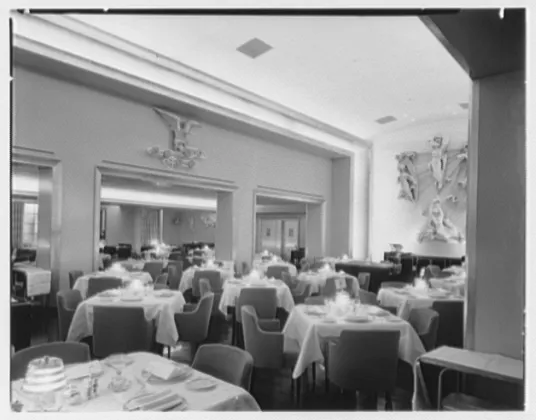
The first-class dining room, photographed in 1953. Gottscho-Schleisner, Library of Congress. Source → Praised on the Senate floor
Sen. Herbert O’Conor of Maryland puts a statement in the Congressional Record praising "the new superliner." He says she could carry 12,000 to 14,000 troops in an emergency.
Source: Congressional Record
The record crossing
On her maiden voyage she crosses from New York’s Ambrose Lightship to Bishop Rock off England in 3 days, 10 hours and 40 minutes, averaging 35.59 knots. That wins the Blue Riband, the first time in about 100 years that an American ship has held it. Coming home, July 10–14, she averages 34.51 knots.
Source: HAER PA-647