
Research & Science / Living Reef
The SS United States Is Becoming a Living Laboratory: Scientists Begin Tracking a New Reef Ecosystem
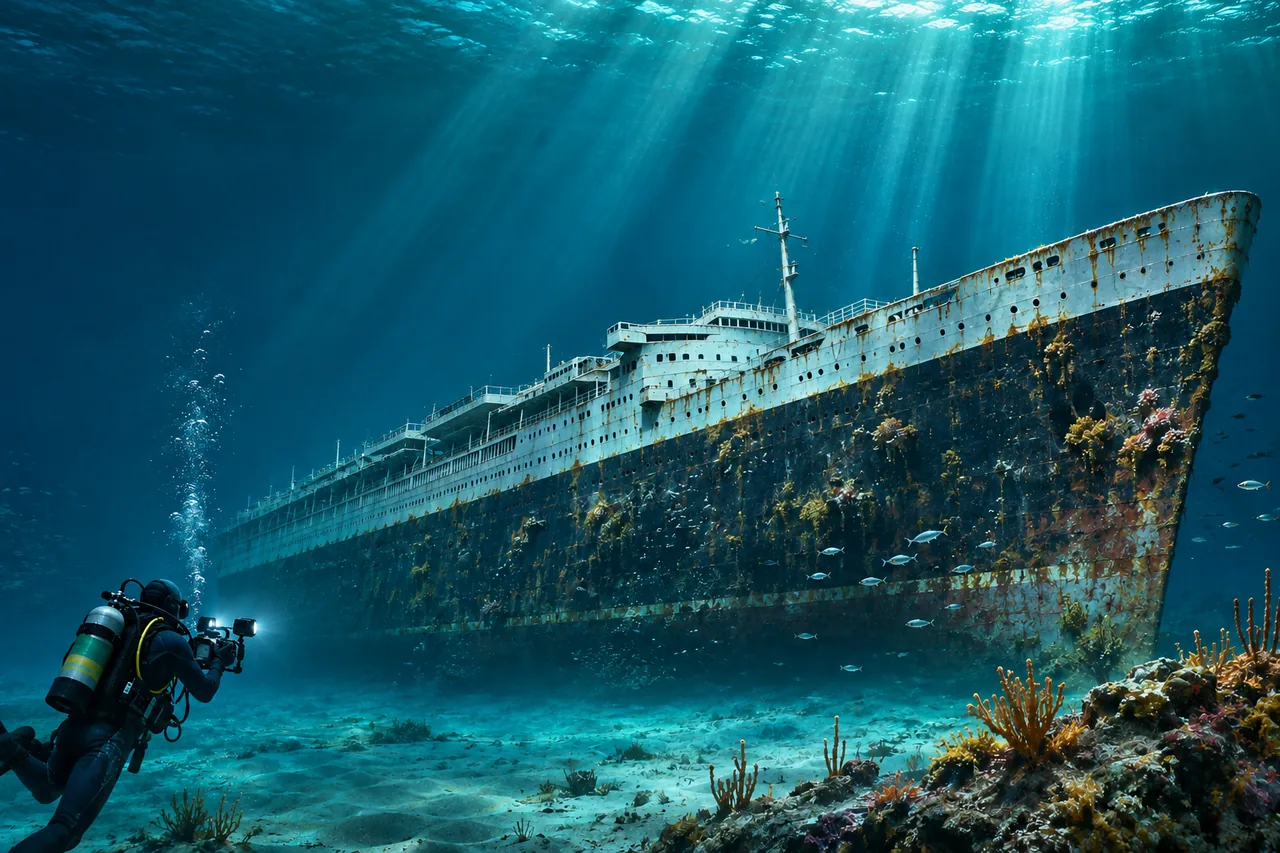
Once the fastest ocean liner in the world, the SS United States now offers scientists a rare chance to watch an underwater ecosystem develop from its earliest days. Off Florida's Gulf Coast, researchers are preparing to document a transformation that could take decades.
“From Liner to Laboratory,” a short narrated overview by BigUReef.com of the SS United States’ second life as an artificial reef and a research site off Destin, Florida. Plays with English captions. .
DESTIN-FORT WALTON BEACH, FLORIDA - November 18, 2026
For more than seven decades, the SS United States was defined by what she could do above the water. She crossed the Atlantic at record-breaking speed, carried generations of passengers, and became one of the most extraordinary achievements in American maritime engineering.
On November 11, 2026, her story changed. The 990-foot ocean liner descended into the Gulf of Mexico, approximately 22 nautical miles southwest of Destin East Pass, beginning a new chapter as the world's largest artificial reef.
But beneath the surface, another story is only beginning.
Scientists from the Woods Hole Oceanographic Institution (WHOI) are preparing to study the vessel's transformation into a living marine habitat - monitoring everything from microscopic organisms and water chemistry to the fish, sponges, and other creatures that may eventually make the ship their home.
The project offers something remarkably uncommon in marine science: the opportunity to study the development of an enormous artificial reef from almost the moment it was created.
A 990-Foot Experiment Beneath the Gulf
Most shipwrecks enter the scientific record long after they have settled onto the ocean floor. By the time researchers encounter them, marine life may have occupied their surfaces for years, decades, or even centuries. Much of the earliest ecological history has already disappeared.
The SS United States is different. Because her sinking was planned and extensively documented, scientists know when the vessel entered the water, where she was deployed, and much about the materials and structures that make up her enormous hull.
This creates an unusual starting point for ecological research. Researchers can examine the ship during the earliest stages of biological colonization, record changes as they occur, and compare observations over successive years.
The work is being led by WHOI researchers, including marine biologist Kirstin Meyer-Kaiser, whose research examines how shipwrecks and other artificial structures influence ocean ecosystems.
Unlike a typical wreck survey, which documents a habitat that already exists, this project is designed to follow the process of habitat formation itself. How does an enormous steel ship become a living reef? Answering it requires looking far beyond the fish that visitors may eventually encounter around the wreck.
The First Inhabitants May Be Almost Invisible
When people imagine an artificial reef, they often picture colorful fish swimming through passageways or corals attached to rusting steel. Yet one of the most important stages of reef development happens on a scale too small for a diver to see.
Microorganisms can settle on newly submerged surfaces, forming communities known as biofilms. These microscopic communities interact with the ship's materials and the surrounding seawater. Over time, they may influence which larger organisms successfully attach to the structure.
Marine ecologists refer to the changing sequence of biological communities as ecological succession. On a shipwreck, this can include microbial establishment, early invertebrate colonization, developing communities of sponges and other attached organisms, and changing fish and crustacean populations.
These are general ecological processes, not a confirmed timetable for the SS United States. Different organisms may arrive simultaneously, and fish can appear around newly deployed structures before large attached communities have developed.
NOAA research on shipwreck ecology emphasizes that wrecks are dynamic habitats. Their biological communities change with depth, light, water movement, material composition, and time. The SS United States offers researchers an exceptional opportunity to investigate those changes at an unprecedented physical scale.
Scientists Will Study Water at 132 Locations Around the Ship
One of the most intriguing elements of the research concerns the relationship between the vessel's steel structure and the surrounding seawater.
As steel remains submerged, corrosion gradually changes its surface and can release elements into the marine environment. Some of those elements, including iron and manganese, play important roles in biological processes. Others may create environmental concerns depending on their chemical form, concentration, and exposure.
Researchers do not want to assume that every effect of a new artificial reef will be beneficial. Instead, they intend to measure what is happening.
According to WHOI's November 11 announcement, scientists plan to collect water samples from 132 locations around the SS United States to investigate elements including iron, manganese, and nickel.
Those measurements can help researchers determine how the ship affects the chemistry of nearby waters and how those changes relate to the developing biological community. WHOI marine chemist Colleen Hansel is among the scientists involved in understanding the environmental response.
Microorganisms can affect corrosion. Corrosion can change the availability of certain elements. Those changes may influence which organisms thrive on different parts of the structure. The ship is not simply a surface on which marine life settles: it is a changing physical and chemical environment.
What Happens to the Seafloor Around the Wreck?
Research will extend beyond the ship itself. Leila Hamdan, a microbiologist at the University of Southern Mississippi, is leading a separate sampling effort focused on microorganisms in the surrounding water and sediment.
An artificial reef can influence nearby habitat even when organisms never attach directly to its structure. The vessel can alter local water movement, introduce new surfaces, change patterns of sediment deposition, and create habitat for species that were previously less common in the immediate area.
Does a large artificial reef create new ecological opportunities, redistribute organisms already living nearby, or produce some combination of both? The answer may vary across species.
NOAA research has shown that shipwrecks can provide valuable habitat while also potentially supporting invasive species or changing surrounding ecosystems. Long-term monitoring will help researchers understand the actual ecological outcome at the SS United States rather than relying on assumptions.
A Living Reef Does Not Appear Overnight
The ship's enormous size makes its transformation particularly fascinating. At approximately 990 feet long, the SS United States contains an extensive range of external surfaces, structural openings, shaded areas, and vertical features.
Areas exposed to stronger currents may develop differently from sheltered sections. Shallow portions may receive different amounts of light than deeper sections. Scientists call such differences in habitat and species distribution ecological zonation.
Over time, observations could reveal distinct communities on different sections of the vessel. Researchers will need years of repeated observations to establish how those communities change, which species persist, and whether the new habitat develops characteristics resembling other artificial reefs in the northern Gulf.
There is no single established timetable for when a newly deployed ship becomes a mature reef. That uncertainty is precisely why this project matters.
Divers Could Help Document the Transformation
One promising element of the WHOI project is the possibility of involving recreational divers in the research.
The scientific team plans to return to the wreck annually to collect samples and photograph its changing condition. But annual surveys leave considerable gaps between observations.
Meyer-Kaiser has identified a potential citizen-science program in which divers visiting the SS United States could contribute underwater photographs to a developing research dataset.
Repeated photographs of the same locations could help scientists observe changes between formal visits. For scientific usefulness, photographs would ideally include dates, locations on the wreck, approximate depths, and consistent views.
The citizen-science program remains a stated long-term goal, not an established public submission system. Nevertheless, its potential is considerable: a visual history of the ship could become a scientific history of reef formation.
Why the Research Could Matter Beyond Florida
Artificial structures are increasingly common in the world's oceans. Offshore wind installations, energy infrastructure, artificial reefs, and sunken vessels introduce hard surfaces into environments that may otherwise contain extensive sand or sediment.
Those surfaces can provide habitat, but their ecological effects are complex. Research has shown that shipwrecks can sometimes act as stepping stones between marine habitats, allowing certain species to establish across previously disconnected areas.
In separate WHOI research reported in October 2026, scientists examined how shipwrecks may help cold-water anemones expand their geographic range.
The SS United States research may eventually inform decisions about artificial reef design, material selection, environmental monitoring, and offshore infrastructure. Its scientific value is not guaranteed by its size alone; it comes from collecting consistent evidence over time.
From Maritime Record to Ecological Record
The SS United States already occupies an extraordinary place in American maritime history. Built as a technological showcase of the postwar era, she established a transatlantic speed record during her maiden voyage in 1952 and became a symbol of American engineering.
Her final voyage brought that history to an entirely different environment. Today, scientists are beginning to examine a transformation measured through water samples, sediment studies, microbial analysis, photographs, and observations of marine life.
Some changes may occur within days. Others may take years. And some of the most important findings may involve unexpected interactions between the ship's steel structure and the organisms living around it.
The SS United States has completed her last voyage across the sea. Her next journey is unfolding beneath it.
Frequently Asked Questions
- Is the SS United States now an artificial reef?
- Yes. The ship was intentionally sunk on November 11, 2026, off Florida's Gulf Coast. The developing biological community is the subject of planned long-term scientific monitoring.
- Who is studying marine life on the SS United States?
- Researchers led by Woods Hole Oceanographic Institution, with additional sampling led by researchers from the University of Southern Mississippi.
- How long will it take marine life to colonize the ship?
- Some colonization processes can begin rapidly, but complex persistent communities may take years. No scientifically confirmed timeline exists for this specific wreck.
- What marine life could live on the wreck?
- Potential organisms include microbes, sponges, corals, attached invertebrates, crustaceans, and reef-associated fish. Actual species need to be documented through observation.
- Can recreational divers contribute?
- WHOI has discussed a future citizen-science initiative involving diver photographs; a public submission system has not yet been announced.
Primary Sources and Further Reading
- WHOI, November 11, 2026 - Primary scientific announcement www.whoi.edu/press-room/news-release/ssus-reef/
- NOAA NCCOS - Scientists Study Shipwrecks to Understand Underwater Ecology coastalscience.noaa.gov/news/scientists-study-shipwrecks-to-understand-underwater-ecology/
- WHOI Ocean Learning Hub - How Do Wrecks Impact Marine Life? www.whoi.edu/ocean-learning-hub/ocean-facts/how-do-wrecks-impact-marine-life/
- WHOI - How Shipwrecks Helped a Cold-Water Anemone Move South www.whoi.edu/oceanus/feature/how-shipwrecks-helped-a-cold-water-anemone-move-south/
- NOAA Library - Shipwreck Ecology: Understanding the Function and Processes from Microbes to Megafauna repository.library.noaa.gov/view/noaa/56240
- UF IFAS - From Ocean Liner to Ocean Life blogs.ifas.ufl.edu/taylorco/2026/11/13/from-ocean-liner-to-ocean-life-the-ss-united-states-begins-a-new-chapter-as-the-worlds-largest-artificial-reef/
More primary documents: county decisions, federal permits, cleanup records and court filings on the reef project are collected in our Crypt of Echoes Archive: SS United States Files.
Editorial note: Research plans reflect public announcements available as of November 18, 2026. Projected ecological changes are distinguished from confirmed observations. Big U Reef is an independent information resource and is not presented as an official WHOI or Okaloosa County partner.