
History · The Record
1952 Maiden Voyage
Noon, July 3, 1952: America’s new superliner leaves New York. Eighty-two hours later she holds the fastest crossing ever made by a liner.
On July 3, 1952, America's new superliner left New York on her first trip with paying passengers. Less than four days later she had crossed the Atlantic faster than any liner before her, and she broke the record again on the way home. This is the voyage day by day.
Before she sailed
- June 1952 · Builder's trialsAt sea off the Virginia Capes, the ship reached 38.32 knots at 247,785 shaft horsepower. Because she was designed to serve as a troopship, the figure was kept quiet for years.Source: HAER PA-647 · Crypt record
- June 25, 1952 · In the SenateSen. Herbert O'Conor of Maryland entered a statement thanking Commerce Secretary Charles Sawyer for pushing through the completion and delivery of the ship, "now entering the oceanic service." The ship's cost to the government was still being argued over in Congress.Source: Congressional Record, June 25, 1952 · Crypt record
- Late June 1952 · Open houseThe ship was opened to visitors at her New York pier. Our Blue Riband article puts the crowd at around 70,000.
Eastbound: the record run
- Thursday, July 3 · Noon · New YorkThe ship left Pier 86 with about 1,700 passengers. Commodore Harry Manning was in command. William Francis Gibbs, who had spent most of his life designing her, was aboard. So was Margaret Truman, the President's daughter. The record clock started when she passed the Ambrose Lightship at the entrance to New York Harbor.
- Friday, July 4 · At seaIndependence Day on the open Atlantic, on the first full day of the run. The ship held a pace no liner had kept before. Liners posted a "day's run," the miles covered noon to noon, for passengers to bet on. We have not found the figures posted on this voyage.
- Saturday, July 5 and Sunday, July 6 · At seaTwo more days at full speed across the North Atlantic. Each night the clocks went forward as she ran east, so the voyage was shorter on passengers' watches than on the official record, which is measured in elapsed time.
- Monday, July 7 · Bishop RockShe passed the Bishop Rock lighthouse off the Isles of Scilly, the end of the record course: 3 days, 10 hours and 40 minutes at 35.59 knots. The Queen Mary's 1938 eastbound record had been 31.69 knots. At that speed the Queen Mary would have needed about ten more hours for the same distance.Sources: HAER PA-647 maiden-voyage table · Crypt record; Wikipedia, Blue Riband
- After Bishop Rock · Le Havre and SouthamptonShe called at Le Havre, France, and then Southampton, England, to crowds on both sides of the Channel. HAER notes she was the first American ship in about 100 years to take the Blue Riband. Margaret Truman went ashore at Southampton to begin a tour of Europe (see Who Sailed Her).
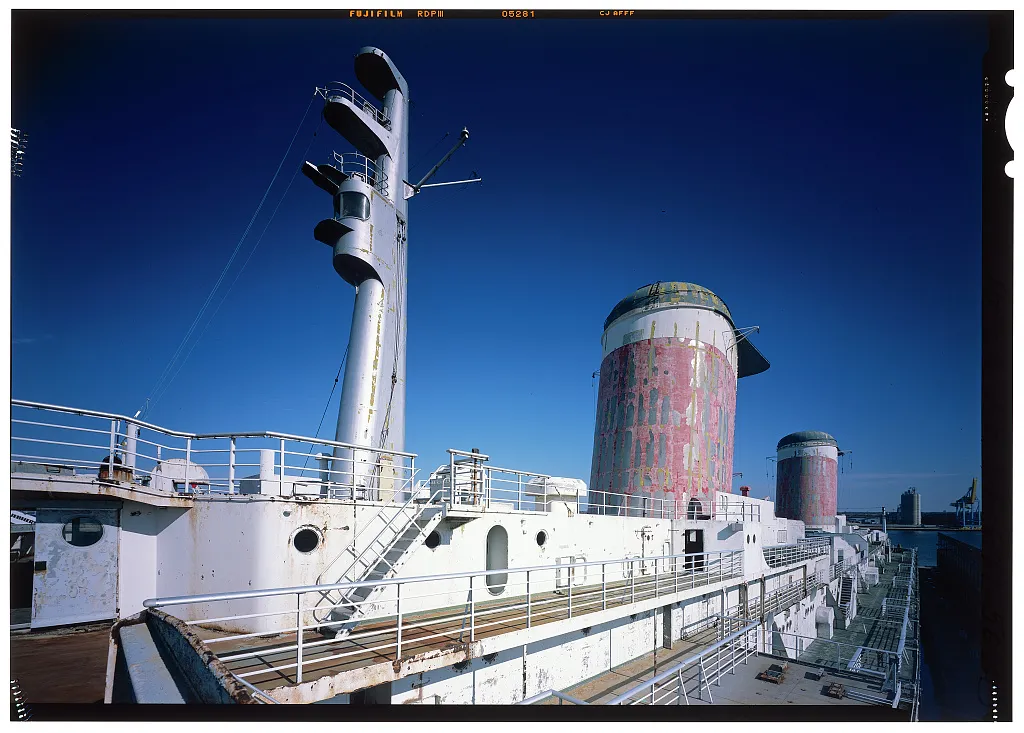
Westbound: proving it
- July 10 · Bishop RockHeading home, she started the westbound course. Westbound is usually the slower direction, against the prevailing wind and the Gulf Stream. Comedian Milton Berle was among the passengers on this first return trip, according to the Statue of Liberty–Ellis Island Foundation.
- July 14 · Ambrose LightshipShe finished in 3 days, 12 hours and 12 minutes at 34.51 knots over 2,906 nautical miles, beating the Queen Mary's 1938 westbound record of 30.99 knots. She now held the record in both directions. (HAER dates the run July 10–14; some secondary sources give July 11–15.)Source: HAER PA-647 · Crypt record
- July 1952 · New YorkThe ship returned to a hero's welcome, and her owners later received the Hales Trophy, the physical trophy for the record. See Blue Riband Records for every holder before and since.
What the trip cost the country
The record came with a political bill. Congress spent 1952 arguing over what United States Lines should pay for the ship and how much of the cost the government should carry for her defense features. The General Accounting Office's 1952 audit of the Maritime Administration (House Doc. 82-472) and the Federal Maritime Board's annual reports for 1950 and 1951 lay out the money side. The Construction Log covers how she got built.
Frequently Asked Questions
- How long did the SS United States take on her maiden voyage?
- Eastbound from the Ambrose Lightship to Bishop Rock she took 3 days, 10 hours and 40 minutes, averaging 35.59 knots over 2,942 nautical miles.
- Who was the captain on the maiden voyage?
- Commodore Harry Manning of United States Lines. The ship's designer, William Francis Gibbs, also sailed.
- When did the maiden voyage leave New York?
- At noon on July 3, 1952, from Pier 86 on the Hudson River, timed to put her at sea on the Fourth of July.
- Is there an hour-by-hour log of the voyage?
- Not in any public archive we have found. The deck and engine logs have not been published, so this page follows the voyage day by day using government records and contemporary accounts.
Sources
- Historic American Engineering Record, SS United States, HAER No. PA-647 (National Park Service), maiden-voyage records table · Crypt: SSUSH-0142
- Congressional Record (Senate), June 25, 1952, statement by Sen. O'Conor · Crypt: SSUSH-0038
- House Doc. 82-472, audit of the Maritime Administration, 1952 · Crypt: SSUSH-0100
- Wikipedia, Blue Riband (Queen Mary 1938 records; westbound dates)
- Wikipedia, Harry Manning
- Statue of Liberty–Ellis Island Foundation, A Look Back at the SS United States (Milton Berle)
Records marked "Crypt" are full copies in the Crypt of Echoes SS United States collection. Spot an error? Tell us.